
Losing weight may be only the first step. Helping the body adapt to its new weight maybe just as important.
Anyone who has lost a significant amount of weight knows that losing it and keeping it off are two very different challenges. This has become especially apparent with highly effective GLP-1 medications. Many patients can now achieve substantial weight loss that once seemed difficult or impossible. But what happens when goal weight is reached? Why does hunger sometimes return? Why can weight begin creeping back despite continued attention to diet and exercise? Emerging research suggests there may be another piece of the puzzle.
Fat Cells May “Remember” Obesity
Scientists call this phenomenon epigenetic memory. Epigenetics refers to changes that influence how strongly certain genes are turned on or off without changing the underlying DNA sequence itself. Some of these changes can persist even after the condition that originally produced them has disappeared.
Recent research suggests that obesity may leave just such a biological imprint in adipose, or fat, tissue. In a 2024 Nature study, researchers found that human adipose tissue retained obesity-associated transcriptional changes even after substantial weight loss. In mice, they also identified persistent epigenetic changes in adipocytes that appeared to prime the animals for more rapid weight regain when they were re-exposed to a high-fat diet. Nature
What Is “Epigenetic Obesity Memory”?
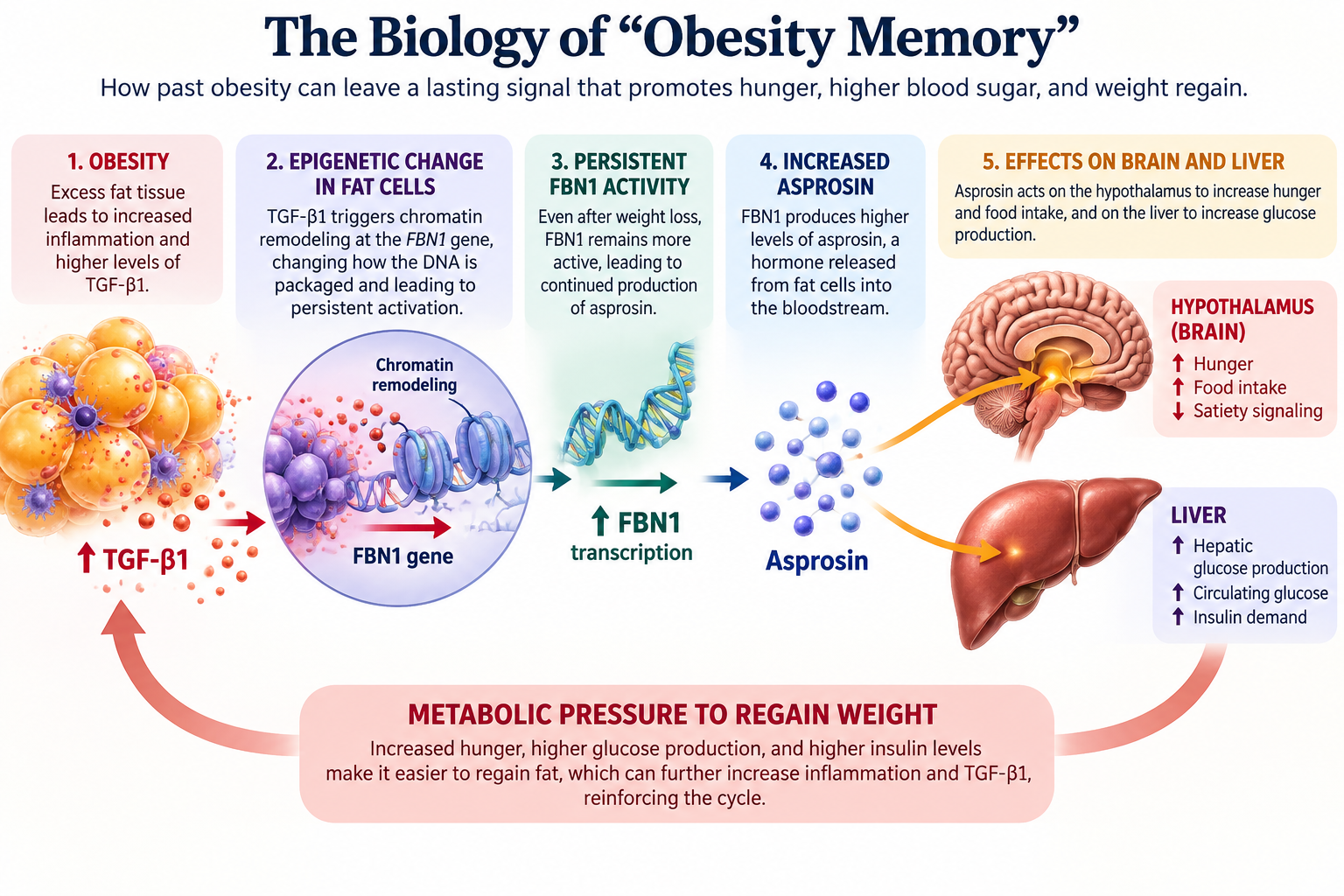
A 2026 study published in Cell Reports identified one possible molecular pathway that may help explain this phenomenon. During obesity, levels of the signaling molecule transforming growth factor beta-1 (TGF-β1) can become elevated. Researchers found that exposure of adipocytes to TGF-β1 altered the way DNA was packaged and regulated around a gene called FBN1, a process known as chromatin remodeling. This matters because FBN1 encodes profibrillin-1, the precursor protein from which the hormone asprosin is generated.
The researchers found that transient exposure to elevated TGF-β1 produced changes at the FBN1 gene that persisted even after TGF-β1 levels normalized. As a result, FBN1 remained more active and adipocytes continued producing increased amounts of asprosin.
In other words, the original metabolic stimulus disappeared, but the fat cells retained a molecular memory of it. ScienceDirect
Asprosin Can Affect Both Hunger and Glucose Metabolism
Asprosin is a hormone produced primarily by white adipose tissue. It has two particularly important actions that connect this emerging obesity-memory pathway with weight and metabolic regulation.
In the brain, asprosin acts on appetite-regulating pathways in the hypothalamus. It activates hunger, promoting neurons and suppresses downstream satiety signaling, thereby increasing appetite and food intake. Nature
In the liver, asprosin stimulates hepatic glucose production. This can increase insulin demand, and persistently elevated insulin can suppress fat breakdown while promoting fat storage, potentially increasing susceptibility to weight regain. PubMed Central (PMC)
Normally, these actions make physiological sense. During fasting, the body needs mechanisms that maintain blood glucose and encourage us to seek food. But what happens if this signal remains elevated after excess weight has already been lost? That is what makes the new research so intriguing.
The Weight Was Gone. The Biological Signal Wasn't.
Researchers found that after previously obese mice lost weight and returned to the same body weight as lean control animals, asprosin remained elevated.
In other words, body weight had normalized, but aspects of adipose-tissue biology had not. When the animals were subsequently exposed again to a high-fat diet, those with a history of obesity regained more weight. Even more interestingly, disrupting the FBN1-asprosin signaling pathway prevented the exaggerated weight regain in the experimental models. ScienceDirect
These findings are preclinical and still need to be confirmed in humans. They do not mean that everyone who has lost weight has permanently altered fat cells or that weight regain is inevitable. But they raise an important possibility: reaching goal weight may not mean that the body's metabolic adaptation to that weight is complete.
Why ThisMatters for People Using GLP-1 Medications
GLP-1–based medications can powerfully reduce hunger, improve satiety, and help patients achieve substantial reductions in body weight. But eventually an important question arises: “I've reached my goal weight. What do I do now?”
Traditionally, the answer has focused primarily on maintaining a healthy diet and exercising. Those remain essential, but they may not tell the whole story.
After significant weight loss, the body may still experience biological pressures favoring weight regain. These can include changes in appetite regulation, energy expenditure, insulin and glucose metabolism, body composition, and potentially persistent signaling from adipose tissue itself.
This suggests that there may be an important transition between losing the weight and becoming metabolically stable at the new weight. We call this period metabolic consolidation.
Goal Weight Should Be a Transition Point, Not the Finish Line
Our approach is based on a simple principle. The goal is not merely to reach a lower number on the scale. The goal is to help the body successfully maintain its new metabolic state. After goal weight is achieved, attention shifts away from active weight loss and toward goal-weight stabilization and metabolic correction.
This may include evaluating insulin and glucose regulation, body composition, skeletal muscle, nutrition, physical activity, appetite and satiety patterns, and other metabolic factors that can influence whether the new weight remains stable.
Why doesmuscle matter?
Skeletal muscle is one of the body's major sites of glucose disposal and an important contributor to insulin sensitivity and metabolic health. Preserving and, when appropriate, rebuilding muscle after substantial weight loss may therefore be particularly important.
Why doesinsulin matter?
A normal glucose level does not necessarily tell us how much insulin the body is producing to maintain it. A person may maintain normal blood glucose while requiring relatively high insulin secretion to do so. Looking beyond glucose alone can therefore provide information about the patient's metabolic state that the scale cannot.
Why mighttime at the new weight matter?
That is one of the important questions raised by emerging epigenetic research. We do not yet know whether maintaining a reduced weight for a prolonged period can reverse the specific adipose epigenetic changes identified in experimental studies. But maintaining the new weight while improving the surrounding metabolic environment may help reduce some of the conditions that favor weight regain.
The Problem With “Lose the Weight and Stop”
This becomes especially important when patients want to reduce or discontinue a GLP-1 medication. Clinical studies demonstrate that substantial weight regain can occur after GLP-1 therapy is withdrawn.
In the STEP 1 extension study, participants who had received semaglutide regained, on average, approximately two-thirds of their previous weight loss during the year after treatment was stopped. Many of the cardiometabolic improvements achieved during treatment also moved back toward baseline. PubMed Central (PMC)
That should not automatically be interpreted as a failure of discipline. If appetite-regulating and metabolic signals are still favoring the previous weight, removing a medication that had been helping oppose those signals may leave some patients biologically vulnerable to regain.
The better question may therefore be: “Is your body metabolically ready to maintain this weight with less pharmacologic support?”
That is very different from simply asking: “Have you reached your goal weight?”
From Weight Loss to Weight-Regain Prevention
For this reason, our weight-management program does not have to end when the desired weight appears on the scale. We have developed a Weight-Regain Prevention Protocol specifically for the period after substantial weight loss.
The first objective is to stabilize the new weight rather than immediately continuing to push the scale lower. We then assess and address metabolic factors that may increase susceptibility to regain.
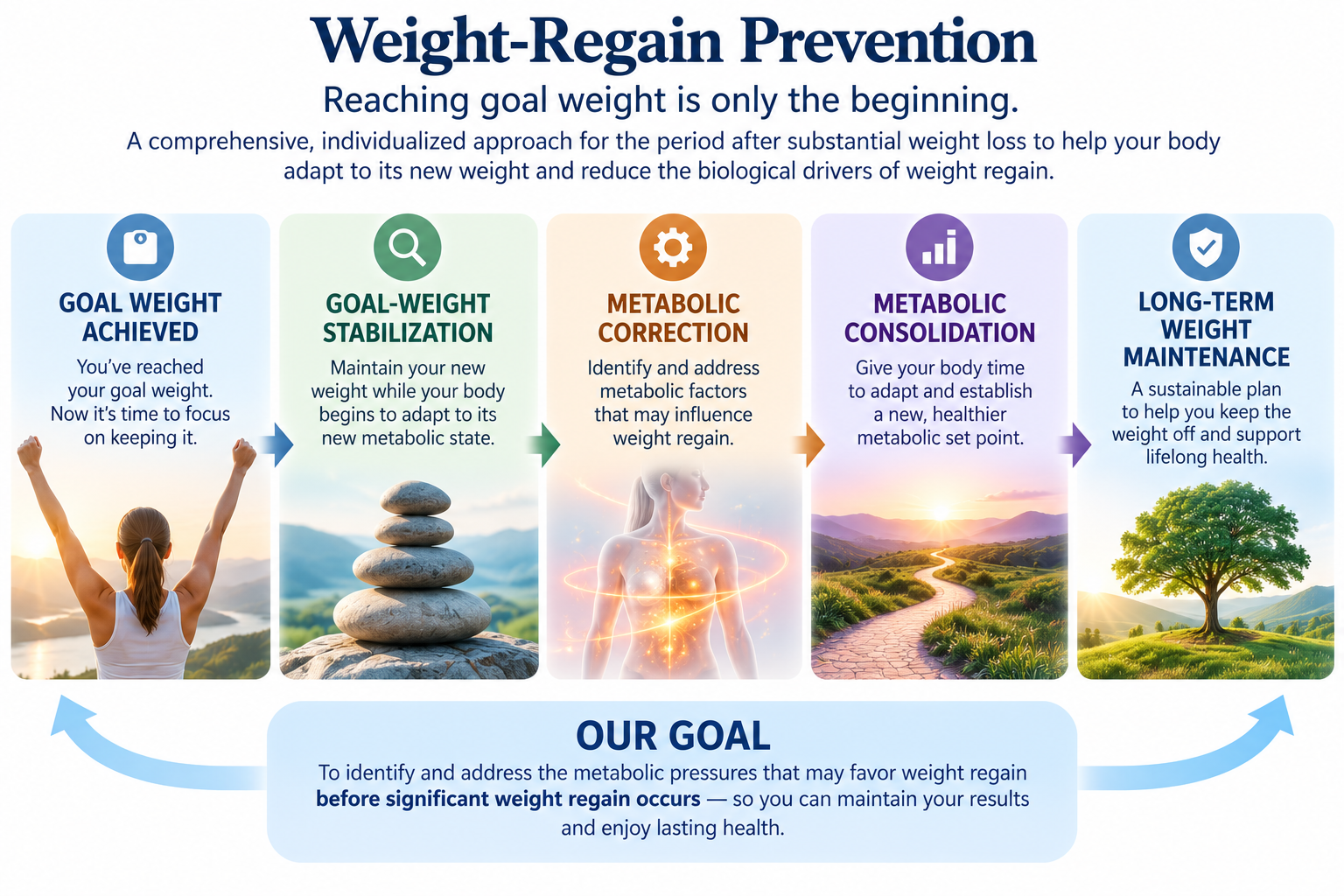
Particular attention is given to preserving and rebuilding metabolically active skeletal muscle and improving insulin and glucose regulation.
The patient then enters a period of metabolic consolidation, during which we work to establish a stable metabolic environment around the new weight. The ultimate goal is a carefully individualized strategy for long-term weight maintenance.
The objective is to identify and address metabolic pressures that may favor weight regain before significant weight regain occurs. This is not simply another diet. Nor is it based on the assumption that every patient should remain on, or discontinue, a GLP-1 medication. Instead, decisions are individualized according to the patient's metabolic health, body composition, appetite regulation, weight stability, response to treatment, and risk of recurrence.
Can We Erase “Obesity Memory”?
We don't know yet. The discovery of persistent FBN1/asprosin signaling is exciting, but the specific mechanism comes primarily from preclinical research. There is currently no proven human treatment that specifically “erases” this epigenetic signal.
The more clinically useful question may therefore be: Can we make that biological memory less likely to translate into weight regain? That means shifting our attention from the scale alone to the metabolic environment surrounding the new weight. Weight loss gets you to goal weight. Metabolic consolidation is designed to help you stay there.
You Reached Your Goal Weight. Now Let's Help You Keep It.
If you have lost significant weight with a GLP-1 medication or through another approach and are concerned about regaining it, reaching goal weight may be the ideal time for your next metabolic assessment.
Our Weight-Regain Prevention Protocol is designed to evaluate your individual risk for weight recurrence and develop a personalized strategy for goal-weight stabilization, metabolic correction, metabolic consolidation, and long-term maintenance.
Rather than waiting for the weight to return, we can begin addressing the metabolic pressures that may promote regain while you are still at, or near, your goal weight.
Contact our office to schedule a Weight-Regain Prevention consultation.
References
- Kim BC, Obeid H, Chen YF, et al. Adipose TGFβ-asprosin memory promotes obesity relapse and offspring obesity susceptibility. Cell Reports. 2026;45(8):117809. doi:10.1016/j.celrep.2026.117809. ScienceDirect Original Cell Reports article
- Hinte LC, Castellano-Castillo D, Ghosh A, et al. Adipose tissue retains an epigenetic memory of obesity after weight loss. Nature. 2024;636:457–465. doi:10.1038/s41586-024-08165-7. Nature
- Romere C, Duerrschmid C, Bournat J, et al. Asprosin, a fasting-induced glucogenic protein hormone. Cell. 2016;165(3):566–579. doi:10.1016/j.cell.2016.02.063. PubMed Central (PMC)
- Duerrschmid C, He Y, Wang C, et al. Asprosin is a centrally acting orexigenic hormone. Nature Medicine. 2017;23:1444–1453. doi:10.1038/nm.4432. Nature
- Wilding JPH, Batterham RL, Davies M, et al. Weight regain and cardiometabolic effects after withdrawal of semaglutide: The STEP 1 trial extension. Diabetes Obes Metab. 2022;24(8):1553–1564. doi:10.1111/dom.14725. PubMed Central (PMC)
Open-access STEP 1 extension

