
Understanding fatty liver through a functional medicine approach
Being told you have fatty liver can be confusing, especially if you eat relatively well, maintain a healthy weight, or have been told that your blood sugar is normal.
Many patients ask, “How can I have fatty liver when Idon't eat much fat?”
The answer may surprise you.
Fatty liver disease, now commonly called metabolic dysfunction-associated steatotic liver disease (MASLD), affects approximately one in three adults. Despite its name, it is not simply caused by eating too much fat.
For many people, fatty liver reflects underlying metabolic dysfunction involving insulin resistance, visceral (abdominal) fat, altered energy metabolism, and other interconnected factors.
Most people have few or no symptoms, and the condition is frequently discovered during routine medical evaluations.
The encouraging news is that liver fat can often be reduced, particularly when the condition is identified early. However, the most important question is not simply whether fatty liver is present.
It is why the liver began accumulating fat in the first place.
Understanding that distinction is central to my approach to metabolic liver health.
Dr.Hubbard's Clinical Perspective
Fatty liver is often an early warning sign that the body's metabolism is under stress.
In my practice, I see patients whose liver imaging shows fatty liver even though their routine blood sugar measurements are within the normal range.
A closer evaluation may reveal insulin resistance, altered lipid metabolism, visceral fat accumulation, declining muscle mass, or other factors that are not immediately apparent.
This is why I do not view fatty liver as an isolated liver problem.
My goal is to understand the metabolic, nutritional, hormonal, and inflammatory processes that may be contributing to each patient's condition—and to determine which deserve the greatest clinical attention.
The diagnosis tells us what is happening. A comprehensive evaluation helps us understand why.
What Causes Fatty Liver?
Your liver plays a central role in regulating blood sugar, processing nutrients, managing fats, and maintaining energy balance.
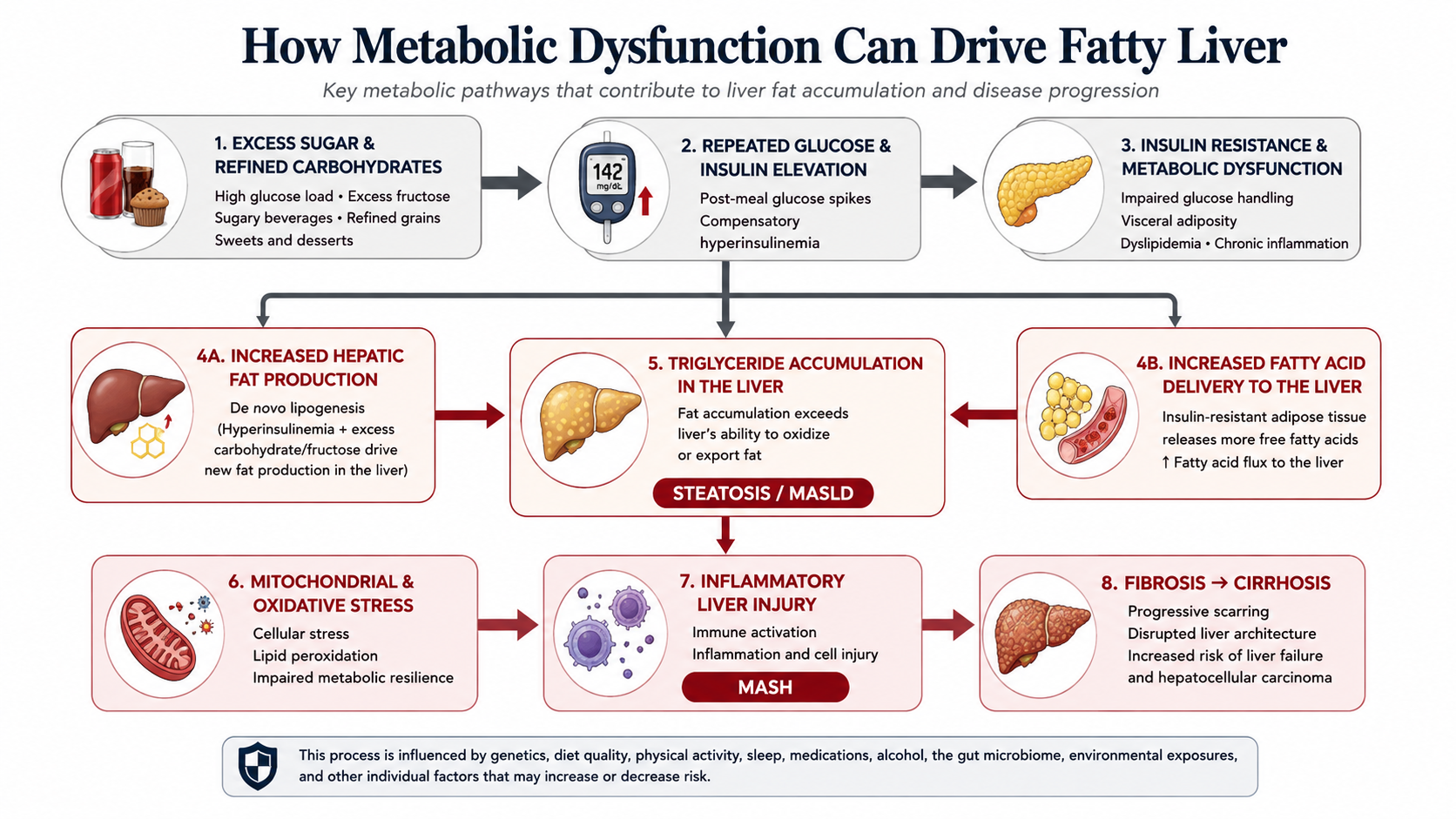
Under normal circumstances, the liver contains relatively little stored fat. Fatty liver develops when the amount of fat entering or being produced by the liver exceeds its ability to use or export it.
One of the most important mechanisms involved is insulin resistance.
Insulin helps regulate how the body uses and stores energy. When cells become less responsive to insulin, the pancreas may compensate by producing more of it.
These metabolic changes can increase the production of fat within the liver while also increasing the delivery of fatty acids from adipose tissue.
This explains why fatty liver is not simply a consequence of dietary fat consumption. The liver can manufacture fat from excess carbohydrates through a process called de novo lipogenesis.
Over time, excessive liver fat may contribute to cellular stress and inflammation. Some patients develop metabolic dysfunction-associated steatohepatitis (MASH), a more serious form of the disease that can lead to fibrosis (scarring), cirrhosis, and other liver complications.
Not everyone with fatty liver progresses to advanced disease. Nevertheless, identifying patients at greater risk is an essential part of responsible medical care.
Why Two People With Fatty Liver May Have Different Underlying Problems
One of the most important things I explain to patients is that fatty liver is not the same metabolic problem in everyone.
Two people may have nearly identical imaging findings yet very different clinical profiles.
One may have significant insulin resistance despite normal blood sugar measurements. Another may have excess visceral fat despite a normal body weight. A third may have altered lipid metabolism, declining muscle mass, or a combination of metabolic and hormonal influences.
Genetic susceptibility, medications, sleep disorders, and other medical conditions may also contribute.
These differences matter because the factors driving liver fat accumulation are not necessarily the same factors driving liver inflammation or fibrosis.
A personalized approach must consider both.
Six Important Factors That May Contribute to Fatty Liver
1. Insulin Resistance
Insulin resistance is a central feature of MASLD in many patients.
It can develop gradually, sometimes years before diabetes is diagnosed. During this period, the body may maintain relatively normal blood sugar levels through compensatory increases in insulin production.
This is one reason why apparently reassuring routine laboratory results do not always provide a complete picture of metabolic health.
2. Excess Sugar and Refined Carbohydrates
Dietary patterns high in added sugars and refined carbohydrates can contribute to liver fat accumulation, particularly when combined with excess energy intake and insulin resistance.
However, the relationship between diet and fatty liver is more complex than simply identifying one problematic food.
The body's metabolic response depends on the overall dietary pattern, energy balance, physical activity, genetics, and existing metabolic health.
3. Visceral Fat
Not all body fat behaves the same way.
Visceral fat surrounds the internal abdominal organs and is metabolically active. It can contribute to increased fatty acid delivery to the liver and altered inflammatory signaling.
Importantly, a person does not have to appear overweight to have excess visceral fat.
This helps explain why fatty liver can occur even inindividuals with a normal body mass index.
4. Skeletal Muscle and Metabolic Health
Skeletal muscle is more than a structure that allows movement. It is also one of the body's major sites of glucose utilization.
Changes in muscle mass, physical activity, and metabolic function can influence insulin sensitivity and the body's ability to regulate energy.
For this reason, body weight alone may not accurately reflect a patient's metabolic health.
5. Metabolic, Hormonal, and Lifestyle Influences
Fatty liver frequently occurs alongside other metabolic conditions, including abnormal lipid metabolism, hypertension, prediabetes, and type 2 diabetes.
Sleep disorders, certain medications, hormonal abnormalities, and genetic predisposition may also influence susceptibility.
These factors often interact rather than acting independently.
6. The Gut-Liver Connection
The digestive tract and liver communicate continuously through the gut-liver axis.
Substances originating in the intestine reach the liver through the portal circulation, creating a close relationship between intestinal function, microbial metabolism, immune signaling, and liver health.
Research suggests that changes in the gut microbiome and intestinal barrier function may contribute to MASLD in some individuals.
However, the clinical significance of these findings varies, and gastrointestinal dysfunction should not be assumed to be the cause of fatty liver in every patient.
The important question is which of these factors are relevant to the individual patient—and how they interact.
Why Fatty Liver Deserves More Attention Than Abnormal Liver Enzymes
Fatty liver is frequently discovered incidentally, sometimes in patients who feel completely healthy.
A common misconception is that normal liver enzymes rule out significant liver disease.
They do not.
Some individuals with MASLD have normal liver enzymes despite substantial liver fat or clinically important fibrosis.
Another important distinction is that the amount of fat in the liver does not necessarily predict the severity of liver scarring.
This is why a comprehensive clinical assessment should consider more than the presence of liver fat alone.
The evaluation must also address the possibility of progressive liver injury and the patient's broader cardiometabolic risk.
MASLD is associated with an increased risk of type 2 diabetes, cardiovascular disease, chronic kidney disease, and liver-related complications. Cardiovascular disease is a particularly important concern in this population.
Recognizing fatty liver early creates an opportunity to evaluate risks that extend well beyond the liver itself.
Why a Comprehensive Evaluation Matters
A diagnosis of fatty liver answers one question: Is fat accumulating in the liver?
It does not necessarily explain what is driving the process or whether the patient is at risk of progression.
I approach this problem by considering three interconnected questions:
What is the current condition of the liver?
Understanding whether there is evidence of ongoing liver injury or clinically significant fibrosis is essential.
What metabolic factors may be contributing?
The relationship between insulin regulation, lipid metabolism, body composition, hormonal function, and other relevant influencescan differ considerably between patients.
What other health risks need attention?
Because MASLD is closely associated with cardiometabolicdisease, a broader clinical perspective is important.
The answers help determine the appropriate direction of care.
Not every patient requires the same investigations, and not every abnormal finding has the same clinical significance. Selecting and interpreting an appropriate evaluation requires consideration of the patient's medical history, symptoms, existing results, and overall risk profile.
A Functional Medicine Perspective: Looking Beyond the Diagnosis
Functional medicine emphasizes understanding how different physiological systems interact and how those interactions may contribute to chronic disease.
In MASLD, this means considering liver health within the broader context of metabolic function rather than viewing fat accumulation as an isolated finding.
My approach combines established medical assessment of liver disease and fibrosis risk with individualized consideration of metabolic, nutritional, hormonal, and lifestyle contributors.
This does not mean that every patient needs extensive testing or that every suspected metabolic imbalance requires treatment.
Instead, the objective is to identify clinically meaning fulfindings, distinguish established risks from emerging mechanisms, and prioritize the factors most relevant to the individual.
The value of a personalized approach lies not in doing more for every patient, but in understanding what matters most for each patient.

Can Fatty Liver Be Reversed?
In many cases, yes.
The liver has a remarkable capacity to recover when the factors contributing to fat accumulation and injury are addressed.
Studies show that liver fat can decrease substantially with improvements in metabolic health. In selected patients, liver inflammation and even fibrosis may improve.
However, the potential for recovery depends on the stage of disease, associated medical conditions, and the extent of existing liver injury.
Patients with advanced fibrosis or cirrhosis require appropriate specialist evaluation and ongoing medical management.
For individuals diagnosed earlier, recognizing the underlying metabolic dysfunction offers an important opportunity to improve long-term health.
The goal is not simply to achieve a normal liver enzyme result. It is to improve liver health while reducing the risk of future metabolic and cardiovascular complications.
FrequentlyAsked Questions
Can I have fatty liver even if I am thin?
Yes. MASLD can occur in people with a normal body weight. Visceral fat, insulin resistance, genetic susceptibility, and other metabolic factors may be present even when body mass index is normal.
Can fatty liver occur with normal blood sugar?
Yes. Some individuals develop insulin resistance before routine blood sugar measurements become abnormal. Normal glucose results do not exclude MASLD.
Does eating fat cause fatty liver?
Not necessarily. Liver fat accumulation is influenced by overall energy balance, insulin resistance, dietary composition, adipose tissue function, and genetic susceptibility. It cannot be explained by dietary fat intake alone.
Can liver enzymes be normal even with significant liverdisease?
Yes. Normal liver enzymes do not reliably exclude fatty liver or clinically significant fibrosis. The need for further evaluation depends on the individual's risk factors and clinical findings.
Is there one best diet or supplement for fatty liver?
No single dietary plan is appropriate for every patient, and supplements should not be assumed to reverse fatty liver. Treatment decisions should reflect the patient's metabolic profile, stage of liver disease, associated medical conditions, and the available scientific evidence.
How do I know whether my fatty liver is serious?
The presence of liver fat alone does not establish theseverity of disease. Assessing the risk of inflammation, fibrosis, and related metabolic complications is an important part of a medical evaluation.
When Should You Consider a Comprehensive Evaluation?
If you have been told that you have fatty liver, it is reasonable to ask whether the diagnosis has been evaluated beyond the initial imaging or laboratory findings.
A more comprehensive assessment may be especially valuable when fatty liver occurs alongside metabolic risk factors, unexplained laboratory abnormalities, a family history of metabolic disease, or uncertainty about the risk of liver fibrosis.
It may also be appropriate when previous recommendations have not adequately addressed the reasons fatty liver developed.
The purpose of a consultation is not simply to repeat the diagnosis, but to understand its significance in the context of your overall health.
Take the Next Step Toward Better Liver Health
Fatty liver is more than a liver diagnosis. It may be an early signal of broader metabolic dysfunction.
Understanding why it developed—and whether there is evidence of progressive liver injury—can make an important difference in long-term health.
At Hubbard Integrative Care, I combine evidence-based medical principles with a functional medicine perspective to evaluate the metabolic factors that may contribute to fatty liver.
My goal is to help patients understand their individual health profile, recognize important risks, and develop a personalized plan based on their clinical needs.
If you have been diagnosed with fatty liver or would like a more comprehensive assessment of your metabolic and liver health, I invite you to schedule a consultation.
Schedule a Consultation
Dr. Ionela O. Hubbard
Selected Medical References
- Rinella ME, et al. A multi-society Delphi consensus statement on new fatty liver disease nomenclature. Hepatology. 2023.
European Association for the Study of the Liver, European Association for the Study of Diabetes, European Association for the Study of Obesity. EASL

